Wing of the Arts · Hall 12
Hall of Writers & Poets
Modelled on Shakespeare's Globe, London, United Kingdom.
- 12 people
- London, United Kingdom
- Built 1599 (original); 1997 (reconstruction)
Who stands here
Shakespeare seated centre stage between the two posts, the scan of a bronze; the others as carved oak steles with their names, years and best-known works: Homer's at the back of the stage under the musicians' gallery, the rest round the yard, facing the stage's middle, in order of birth: antiquity and Asia on the right (+X), from Virgil by the entrance to Cervantes before the stage's corner; modern Europe and the world on the left (−X), from Goethe to García Márquez.- 11564 – 1616William ShakespearePlaywright and poet; Hamlet, King Lear, the Sonnets
- 2fl. c. 8th century BCEHomerThe Iliad, The Odyssey
- 370 – 19 BCEVirgilThe Aeneid
- 4701 – 762 CELi BaiQuiet Night Thought
- 5c. 973 – c. 1014 CEMurasaki ShikibuThe Tale of Genji
- 6c. 1265 – 1321Dante AlighieriThe Divine Comedy
- 71547 – 1616Miguel de CervantesDon Quixote
- 81749 – 1832Johann Wolfgang von GoetheFaust, The Sorrows of Young Werther
- 91802 – 1885Victor HugoLes Misérables, Notre-Dame de Paris
- 101828 – 1910Leo TolstoyWar and Peace, Anna Karenina
- 111861 – 1941Rabindranath TagoreGitanjali
- 121927 – 2014Gabriel García MárquezOne Hundred Years of Solitude
Floor plan
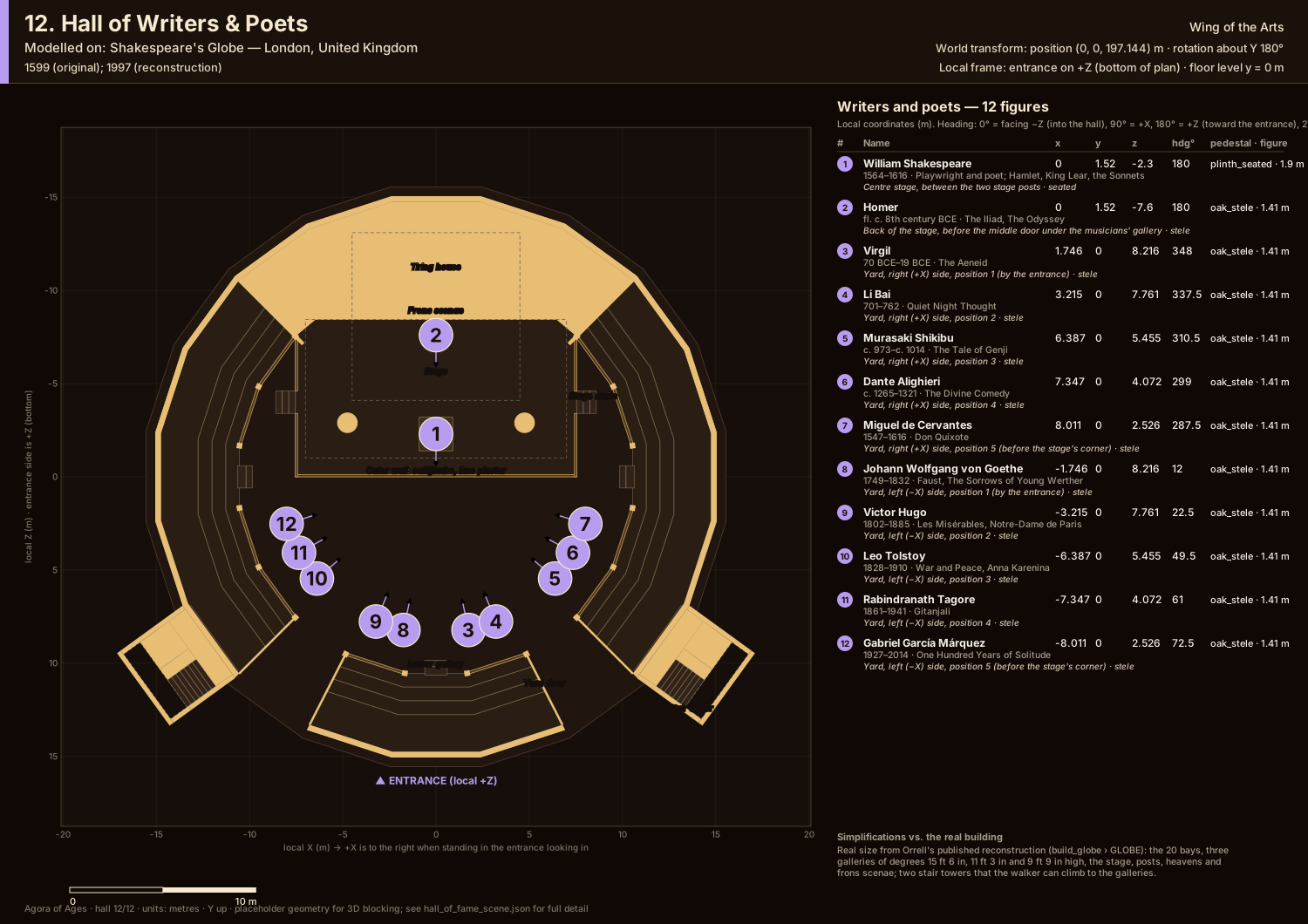
In metres, the entrance at the bottom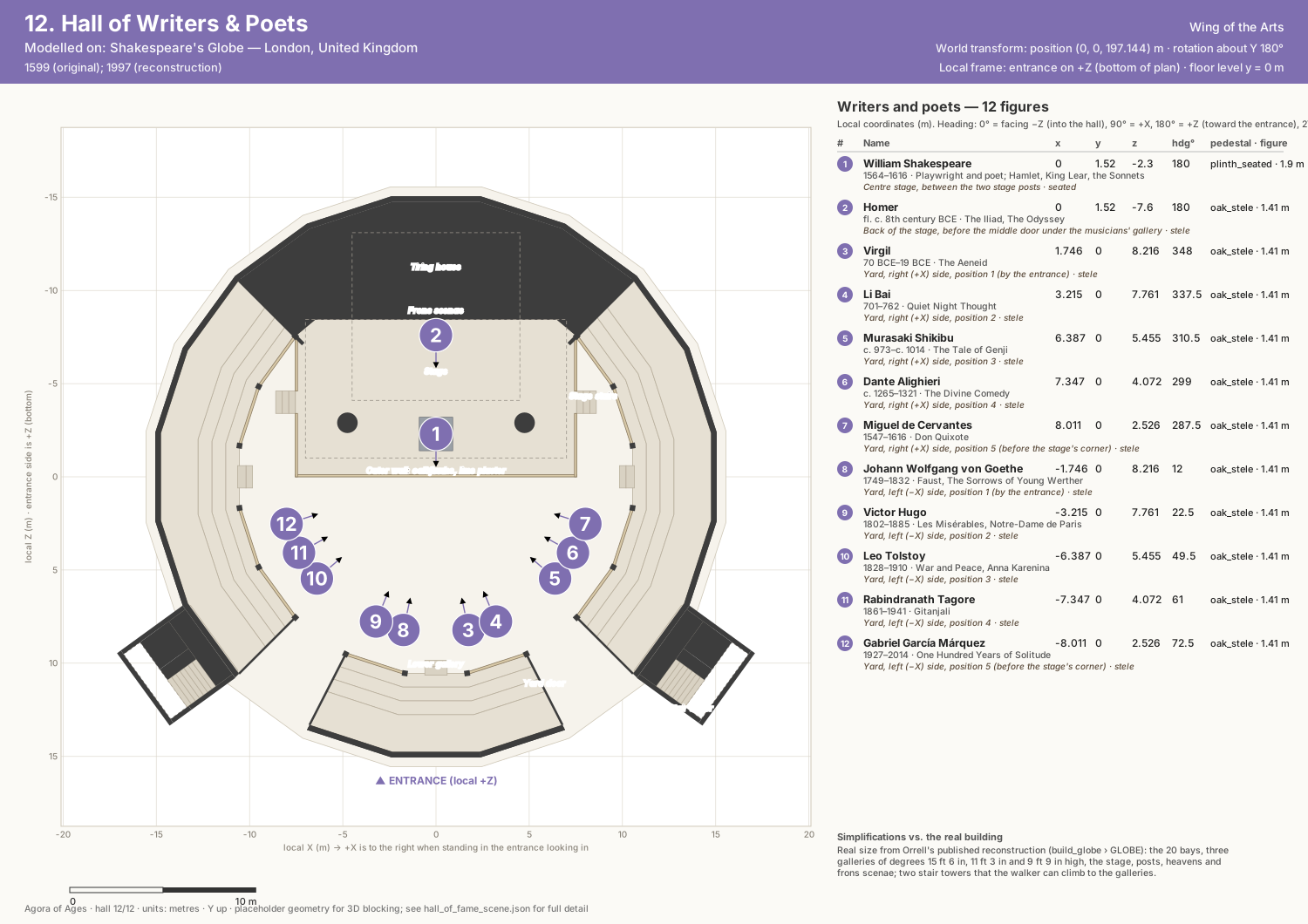
The building
Shakespeare's Globe
Twenty-sided open-air playhouse of oak, lime plaster and water reed, 100 ft (30.5 m) across, rebuilt on Bankside to John Orrell's reconstruction of the 1599 Globe: three galleries round a yard 70 ft across; a stage 5 ft high thrust to the yard's middle under the painted heavens on two marbled posts; the frons scenae with three doors and the lords' rooms above them.
Shakespeare's Globe on WikipediaThe model
The walk shows the Globe as rebuilt in 1997, whole and at real size from the published dimensions of Orrell's design: the twenty bays of oak frame and lime plaster with their small mullioned windows, the brick plinth, the two yard doors and the two stair towers beside them (where OpenStreetMap has them); the roof of water reed, thick at the eaves; inside, three galleries of stepped benches 15 ft 6 in, 11 ft 3 in and 9 ft 9 in high, the upper two jettied a foot into the yard behind turned balusters, the gentlemen's rooms by the stage painted in grisaille; the stage with its stairs, the two posts of red marble under gilt capitals, the heavens of the zodiac round a sun, the cover's lead and gable; the frons scenae with its middle door, two arched doors, marbled columns and painted panels, the lords' rooms and the musicians' gallery over them behind a balustrade, the frieze of the planets' gods. The painted work is cut from photographs of the playhouse and straightened. The stair towers' stairs climb to the back of each gallery; the tiring house is shut. The yard is concrete, as at the Globe today. The carved herms and the figures in the frons's niches are simplified to turned shapes; the lords' rooms' furnishing and the theatre's modern lights are left out. The writers but Shakespeare stand as memorial boards of carved oak 2.4 m high, which the Globe does not have, made in the idiom of its joinery: a moulded foot with scrolled brackets, a framed board with two sunk panels (a raised lozenge below, the inscription above), a cornice and a pediment with a carved fan and ball finials; the name, years and best-known work are cut in the upper panel and gilded.


