Wing of the Arts · Hall 7
Hall of Composers
Modelled on Musikverein, Großer Saal (Golden Hall), Vienna, Austria.
- 11 people
- Vienna, Austria
- Built 1870 (Theophil Hansen)
Who stands here
The Viennese classics at the front of the podium (Beethoven in the middle, Mozart and Haydn either side of him), where they read from the parterre; the others before the parterre boxes facing the middle aisle, the Baroque by the rear balcony, the Romantics toward the podium: Bach, Handel, Schubert and Brahms on the left, Chopin, Tchaikovsky, Wagner and Verdi on the right.- 11770 – 1827Ludwig van BeethovenNine symphonies; bridge from Classical to Romantic
- 21756 – 1791Wolfgang Amadeus MozartOperas, symphonies, concertos; Requiem
- 31732 – 1809Joseph Haydn'Father of the symphony' and of the string quartet
- 41685 – 1750Johann Sebastian BachBaroque master; fugues, cantatas, the Passions
- 51685 – 1759George Frideric HandelOratorios and operas; Messiah
- 61797 – 1828Franz SchubertLieder, symphonies, chamber music
- 71833 – 1897Johannes BrahmsSymphonies, concertos, A German Requiem
- 81810 – 1849Frédéric ChopinPoet of the piano
- 91840 – 1893Pyotr Ilyich TchaikovskyBallets, symphonies, concertos
- 101813 – 1883Richard WagnerMusic dramas; the Ring cycle
- 111813 – 1901Giuseppe VerdiItalian opera; Rigoletto, Aida, Otello
Floor plan
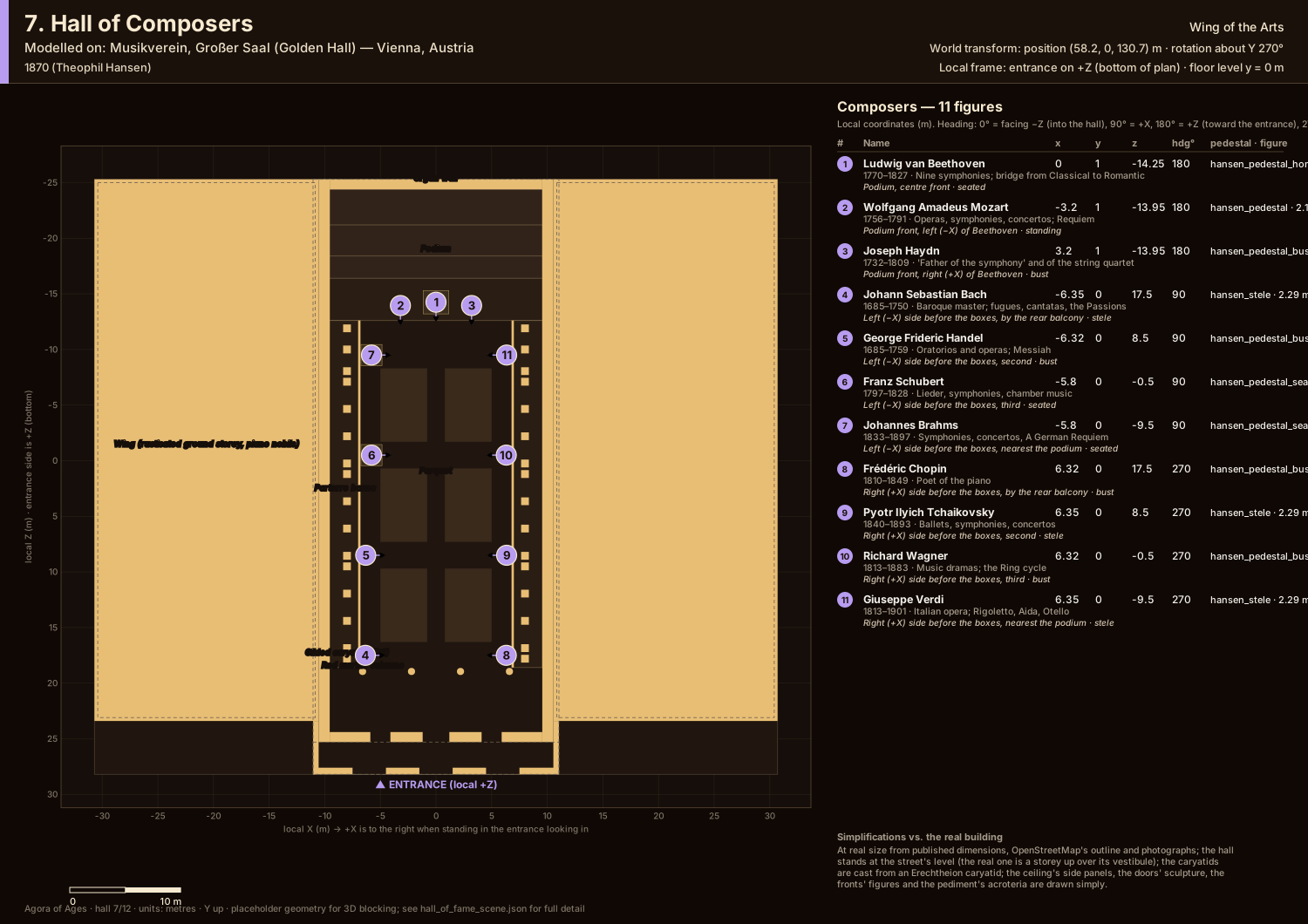
In metres, the entrance at the bottom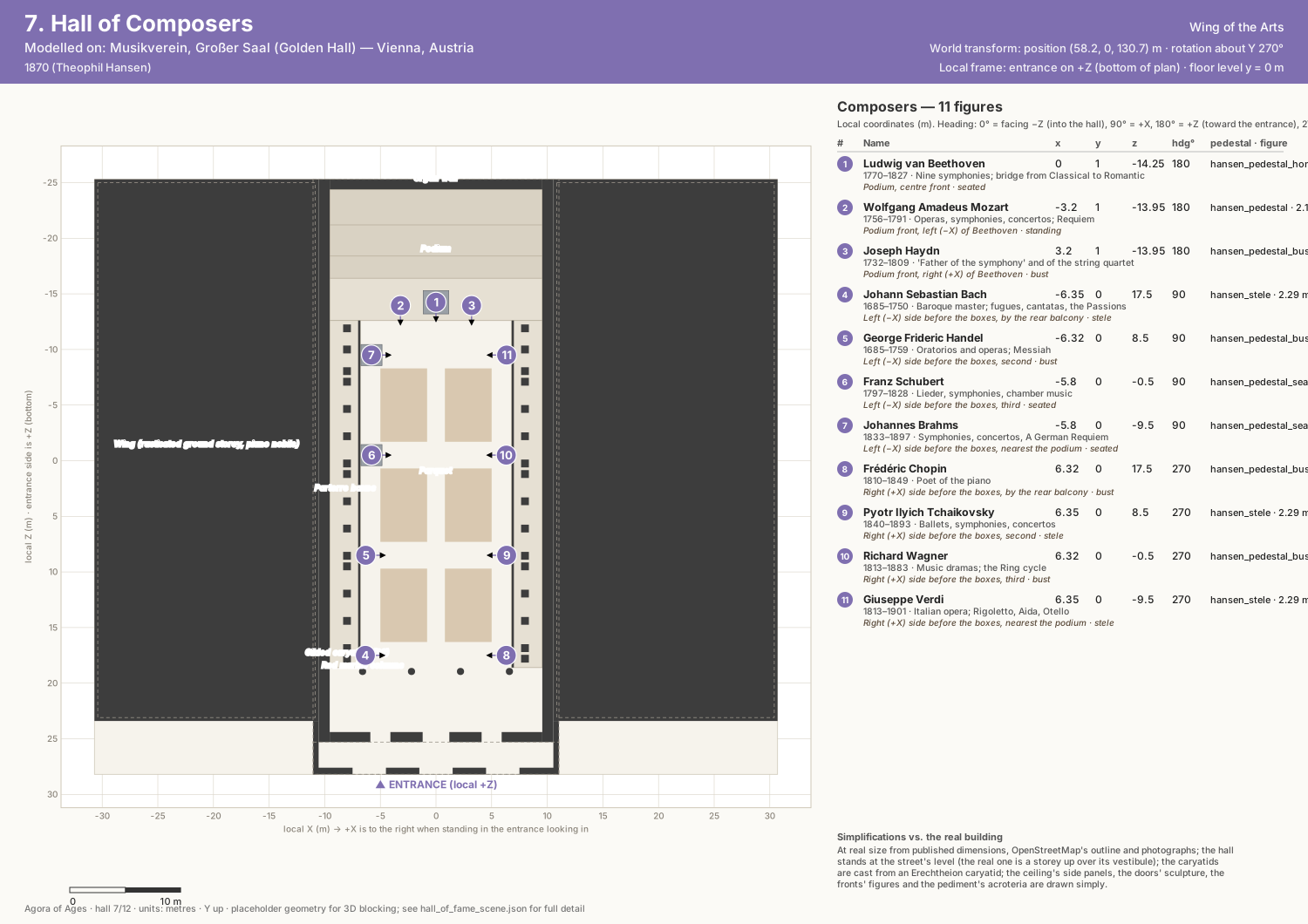
The building
Musikverein, Großer Saal (Golden Hall)
Shoebox concert hall 48.8 × 19.1 m and 17.75 m high, its balcony carried on 32 gilded caryatids over the parterre boxes and across the rear on four columns of red marble; a gilt coffered ceiling with August Eisenmenger's paintings of Apollo and the nine Muses; Hansen's organ case over the podium; home of the Vienna Philharmonic and the New Year's Concert. The building on Karlsplatz, in terracotta red and ochre, has a gable front with a loggia of three arches under the society's pediment.
Musikverein on WikipediaThe model
The walk shows the hall at real size, its levels measured on photographs of its organ end and its sides: the parquet; the parterre boxes behind their parapets of crimson damask and velvet; at their back the 32 gilt caryatids on gilt pedestals, carrying the balcony's beam; the balcony round three sides on its coffered soffit, its gilt balustrade of griffins either side of a lyre, the rear balcony on four fluted columns of red marble; the walls with the balcony's doors under pediments, the tall round-headed windows between gilt pilasters, the frieze of masks and garlands, the gilt cornice; the ceiling in ten bays of gilt frames on a ground of gilt scrolls, Eisenmenger's ten paintings in their middle in the order they hang; the podium in its tiers, the organ gallery's bowed front and the organ case over it, the blind arcade above; ten crystal chandeliers and the parterre's seats. Outside, the building after OpenStreetMap's outline and photographs of its fronts: the long sides' nine bays between broad cream pilasters with ochre Ionic capitals, the ground storey's rusticated piers and the bays set back between them (glazed doors, the side portal, the mezzanine windows between relief panels, display cases), the piano nobile in terracotta red with its tall windows under pediments and the small square windows over them, every window a real opening with its reveal, box casements and glass reflecting the sky over a room, the balustrade panels under them, the entablature with its dentils and modillions, the balustrade of ochre balusters with terracotta putti and white figures at the corners; the gable block with its three doors, the loggia's three arches with a statue in each, the arcade of small windows, the frieze GESELLSCHAFT DER MUSIKFREUNDE and the pediment's relief; the hall rising over the wings with its windows and roof; the pavement of pale granite round it. The real hall is a storey up over its vestibule: here its floor is the street's, entered through the front's doors. The Musikverein's own caryatids (half figures with their arms crossed, rising from tapering shafts) have no scan: they are cast from a sculpted plaster caryatid of their kind, with her arms whole and a basket of grapes under her capital, gilt as leaf burnished on the crests; the ceiling's side panels, the doors' sculpture and the fronts' figures are modelled simply (the putti in rounded masses, the white figures from a scan of an Erechtheion caryatid).


